
Last Updated: October 28, 2026
Quick Summary
Natural executive headshots come from preparation, not from the camera. Plan the session weeks ahead, wear clothes you already feel good in, keep grooming close to your everyday look, and use relaxed posture with a slight body turn. Choose soft lighting and light retouching that keeps your real features.
- Book the session a few weeks ahead, on a day with no deadline pressure.
- Wear solid colors or subtle patterns, and avoid logos or bright colors.
- Get a haircut one to two weeks before the session so it has settled.
- Shift your weight and turn your body slightly rather than squaring up to the camera.
- Remove temporary blemishes, but keep moles, scars and skin texture.
Table of Contents
- Start With Preparation: Wardrobe, Grooming and Session Planning
- Executive Headshot Poses That Feel Relaxed
- Expressions That Look Confident, Not Forced
- Lighting, Backgrounds and Working With Your Photographer During the Session
- Judging Whether Your Executive Headshot Looks Natural and Booking Your Session
- Frequently Asked Questions
Getting a natural-looking executive headshots starts well before the camera comes out. Most stiff, staged portraits come from sessions that were rushed, poorly planned, or built around the wrong clothes. The good news is that most preparation is simple to do.
Here is the core idea: an executive headshot should look like you on your best day, not like a stock photo model. Everything below supports that goal.
Start With Preparation: Wardrobe, Grooming and Session Planning
Preparation decides how relaxed you will feel in front of the lens. A calm, planned session can help you feel more relaxed in front of the lens.
Plan the session a few weeks ahead for your executive headshots. Book a date when you are not under deadline pressure, and schedule it for a time of day when you are alert.
Choosing What to Wear for Your Executive Headshot
Pick clothing you already wear and feel good in. Clothes you have to adjust all session will show in your shoulders and face.
- Choose solid colors or subtle patterns. Busy prints compete with your face.
- Wear a jacket or structured top if it matches your role, but test how it sits when you sit down.
- Avoid logos, large text, and bright colors that pull attention from your expression.
- Bring one backup outfit so you can compare options on camera.
Grooming Without Losing Your Recognizable Look
Grooming should make you look like yourself at your sharpest. Anyone who knows you should still recognize you in the photo.
- Get a haircut one to two weeks before the session, so it has settled.
- Keep makeup and skincare close to your everyday routine.
- Trim facial hair cleanly and keep the style you normally wear.
Executive Headshot Poses That Feel Relaxed
Posing is where many people tense up. Small changes in angle and weight shift can affect how a pose looks.
Body Angle, Posture and Eye Contact
A slight turn of the body can create a different look from squaring up to the camera.
- Sit or stand tall with a relaxed back, not a rigid one. Imagine a string lifting the crown of your head rather than pulling your shoulders back.
- Shift your weight onto one leg or one hip. A dead-even stance reads as stiff on camera.
- Lean slightly toward the camera from the waist to add engagement without hunching.
- Let your hands do something. One hand resting on a lapel, a chair back, or the opposite forearm gives them a home and stops the “arms pinned to the sides” look.
- Drop your chin a touch and push your forehead slightly toward the lens. This avoids the double-chin angle that a raised chin creates.
Direction by Role and Industry
Broad posing advice lands differently depending on what your portrait needs to signal. A few patterns worth knowing before you arrive:
- Finance, law, and consulting: A more squared, formal stance with a jacket and a steady, closed-mouth or slight smile creates a formal look.
- Technology and startups: A looser stance, an open collar, and a warmer expression create a more relaxed look.
- Healthcare and education: A softer body angle and a genuine smile create a less formal look.
- Creative fields: A hand near the face or a more dynamic angle can create variation.
Posing for Different Body Types and Mobility Needs
Not every pose works for every body.
- If you use a wheelchair or mobility aid, consider how you want it represented in the frame.
- If you are seated, you can angle the chair slightly away from the camera.
- If you are self-conscious about your arms or midsection, you can try a three-quarter turn with one arm slightly forward.
Ask your photographer to show you the back of the camera after the first few frames. Seeing what is working early makes it easier to relax into the rest of the session.
Expressions That Look Confident, Not Forced
A confident expression is calm and steady. A forced smile usually shows up as tight cheeks and a stiff jaw.
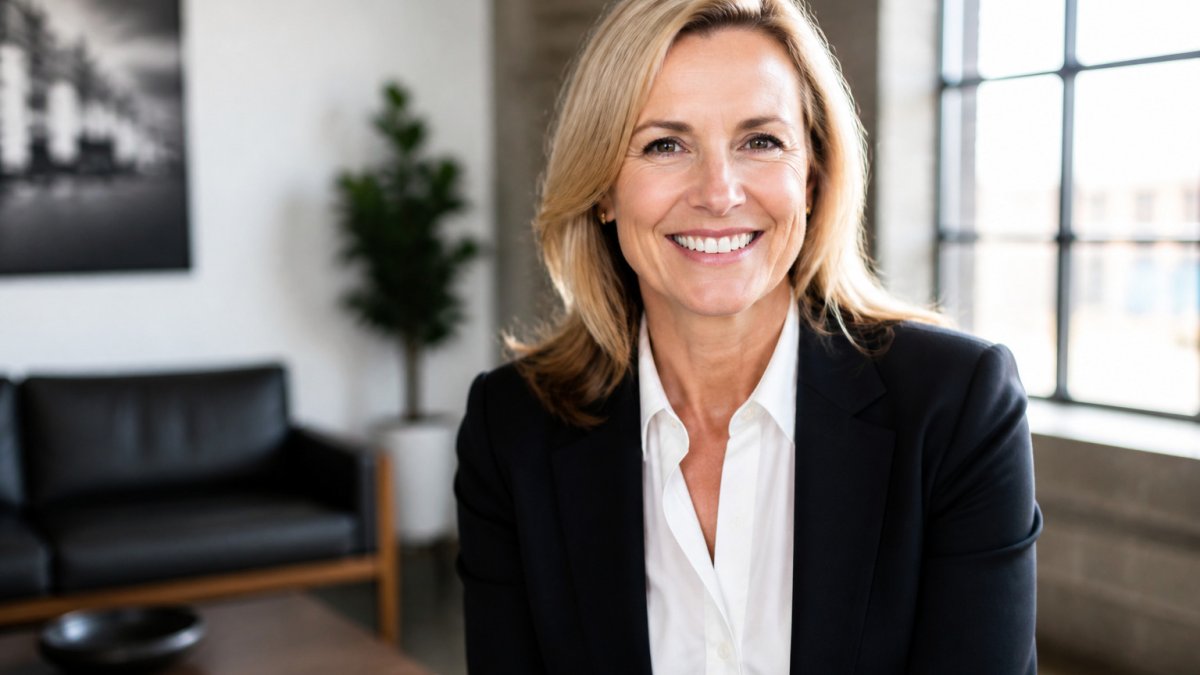
!A confident executive in business attire smiling warmly during a portrait session in a bright studio with soft backlight
Try thinking about something you enjoy before the shot. You can browse the headshot gallery to see examples of confident executive portraits.
Lighting, Backgrounds and Working With Your Photographer During the Session
Good lighting shapes how your face reads. Soft, even light and a simple background create a different look. My Photography Approach explains the studio’s approach.
Speak up during the session if something feels off.
Judging Whether Your Executive Headshot Looks Natural and Booking Your Session
Once you have images to review, check them against a simple test: does the photo look like you talking with a colleague, or like a model posing? If the face looks rigid or the shoulders look tense, the shot probably needs another try. The sections below offer a checklist and a session workflow.
A Review Checklist for Natural-Looking Headshots
Run each candidate image through these questions before you commit to a final selection.
- Resemblance: Would someone who knows you recognize you instantly, without context? If the retouching has smoothed away a mole, a scar, or a characteristic feature, the image has gone too far.
- Expression: Are the eyes engaged and the forehead relaxed? A flat stare or a clamped jaw signals a forced shot.
- Posture: Do the shoulders look level and relaxed, or are they raised toward the ears? Raised shoulders read as tension.
- Lighting: Is the light soft and even across the face, with a catchlight in the eyes? Harsh shadows under the eyes or nose age the subject.
- Retouching: Can you still see skin texture, pores, and fine lines? A plastic, airbrushed look is the most common giveaway of an unnatural executive portrait.
- Background: Does the background separate you from the wall, or does it compete? A simple, slightly out-of-focus backdrop keeps attention on the face.
A Practical Guide to Natural-Looking Retouching
The goal of retouching is to remove temporary distractions, not to change who you are. Retouching can be used to address temporary distractions while preserving permanent features.
- Remove temporary issues: blemishes, stray hairs, shine on the forehead, and lint on a jacket are fair game.
- Preserve permanent features: moles, freckles, scars, and the shape of the nose and jaw should stay. Removing them makes the portrait look like someone else.
- Keep skin texture: over-smoothing is the fastest way to make a headshot look artificial. Texture should still be visible at full resolution.
- Even out tone, not structure: color correction and light dodging are fine; reshaping the face is not.
- Check the eyes and teeth: whiten slightly if needed, but avoid the unnaturally bright, uniform look that reads as retouched.
If a retoucher cannot tell you what they changed, ask. A natural-looking executive headshot should survive a side-by-side comparison with you in person.
A Complete Session Workflow and Preparation Timeline
Here is a workflow to consider.
- Four to six weeks out: Book the session and confirm the deliverable format (web, print, or both). Decide whether you need one look or several.
- Two weeks out: Get a haircut or trim, and finalize wardrobe. Try on each outfit seated and standing to check how it moves.
- One week out: Confirm the session time, location, and any accessibility needs. Gather two outfit options and any props you want.
- The day before: Hydrate, avoid a heavy salt or alcohol load, and get a full night of sleep. Lay out clothes and check for wrinkles.
- Session day: Arrive ten minutes early, review the shot list with the photographer, and ask to see the back of the camera early.
- Within a week after: Review proofs against the checklist above, select finals, and request retouching notes in writing.
When you are ready to move forward, contact Hillary Moore to check current pricing.
Preparation, direction during the session, and restrained retouching are considerations for an executive headshot. Treat the review checklist and timeline as points to consider.
Frequently Asked Questions
How do you look natural in an executive headshot?
Natural executive headshots come from relaxed posture, a slight lean toward the camera, and an expression that starts with a thought rather than a forced smile. Practice a few sentences before the shoot so your face is already animated when the camera opens. Consider practicing a few expressions so you can compare them and pick the one that looks most like you on a good day.
What should you wear for an executive headshot?
Choose timeless business attire in solid colors or subtle patterns that fit well at the shoulders and neckline. Avoid large logos, busy prints and high-contrast stripes that can distract from your face. Bring two or three options so you can compare them on camera, and pick the one that makes you feel most confident. Simple jewelry and eyeglasses that you wear daily are usually fine, and they help the photo look like you.
How should you prepare for an executive headshot session?
Plan the session at least a week ahead. Consider how you plan to use the images, such as on a company website, LinkedIn profile or conference bio. Get a haircut and grooming done a few days before, not the morning of, so you look fresh rather than freshly trimmed. Sleep well, hydrate and bring your wardrobe options on a hanger to keep them wrinkle-free. Ask about the expected turnaround and which files will be provided.
What background works best for an executive headshot?
Background color is one factor to consider when choosing a look for your headshot. A background with soft blur creates a different look from a plain wall. Consider how the background’s appearance fits the look you want. Consider what backdrop suits the look you want.
Watch out: Avoid last-minute wardrobe changes on shoot day. A new outfit that you have not worn often can make you feel self-conscious, which shows in your expression.



0 Comments